

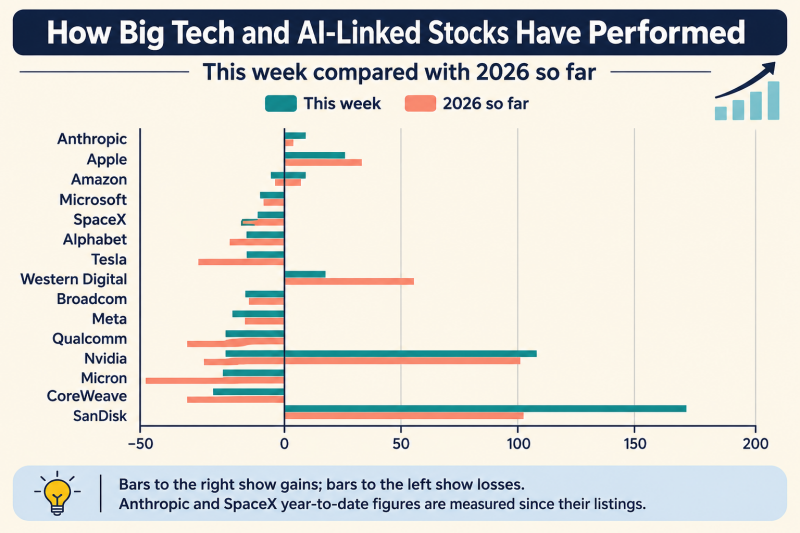
Wall Street has suffered a sharp sell-off as growing concerns about the artificial intelligence (AI) boom have shaken investor confidence. Technology stocks have come under heavy pressure, with some of the biggest names in the industry experiencing significant losses.
The Nasdaq 100, which tracks 100 of the largest non-financial companies listed on the Nasdaq exchange, fell 10.4% in a single week, marking its worst weekly performance since March 2020. The index has now dropped more than 20% from its October peak, officially entering what investors call a bear market.
A bear market is generally defined as a decline of 20% or more from a recent high. The sell-off has also wiped out the Nasdaq 100's gains for 2026, while the S&P 500 has managed to remain slightly positive for the year.
Nvidia takes a massive hit
One of the biggest casualties was AI chipmaker Nvidia. Its shares plunged 14% in Friday's trading session, wiping approximately $493 billion off its market value in just one day.
The decline followed news that the US Securities and Exchange Commission (SEC) was investigating the company's accounting practices. The development added to concerns surrounding the technology giant.
Meanwhile, AI company Anthropic also saw its shares fall 8.5%, just one day after its highly anticipated stock market debut.
Why are investors worried?
The recent market turmoil reflects growing concerns about the enormous amounts of money technology companies are spending on AI infrastructure, including advanced computer chips and data centres.
Investors are beginning to question whether these massive investments will eventually generate enough profits to justify their costs. As a result, enthusiasm surrounding AI has given way to uncertainty.
During periods of market stress, investors often move money into assets considered safer. This time, demand for US government bonds increased, while Wall Street's VIX volatility index, often called the market's fear gauge, climbed above 35.
The takeaway
Even the biggest technology companies are not immune to market downturns. When investor confidence weakens, highly valued stocks can fall sharply. This is a reminder that investing involves risks, and diversification can help reduce exposure to any single sector.